PTSD – Center
High-Value Training Opportunities

Learn, Grow, Transform

At PTSD Center, we believe that continuing professional development is essential to providing outstanding care. Our courses, workshops and training events are designed to deepen knowledge, refine skills and equip mental health professionals. With a practical, evidence-based approach, we provide enriching learning experiences that make a difference to trauma care and the promotion of wellbeing.

🚀 Invest in your professional growth and explore our training courses!

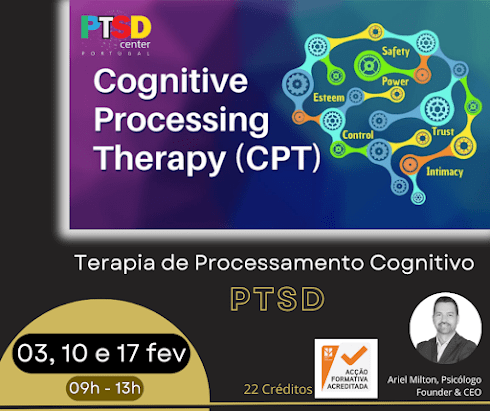
Cognitive Processing Therapy (CPT) – Self-paced course in Portuguese
Cognitive Processing Therapy (CPT) is an effective cognitive behavioural treatment for post-traumatic stress disorder (PTSD), trauma and more. It is one of the most scientifically validated treatments for trauma and is recommended by leading clinical guidelines. It has been tested in several controlled studies involving adults and adolescents who have experienced a wide range of traumatic events. CPT not only helps people recover from acute, emerging or complex PTSD, but can do so more quickly and with lower dropout rates than other treatments… In this course, you will learn to apply CPT techniques in your clinical practice, step by step, session by session, helping your patients understand and change unhelpful thoughts and behaviours.


COURSE DELIVERED IN PORTUGUESE. - Trainer: Ariel Milton (PTSD Center Portugal), trainer & facilitator in Cognitive Processing Therapy. - 13 modules featuring role-play intervention videos with patients (in English)
COMPRAR

Training area: Clinical and Health Psychology 

PTSD Center Training 1
Online Training – 10th Edition – Schema Therapy
Trainer: Sérgio Fonseca (Psychologist)
Co-trainer: Ariel Milton (Psychologist)
Duration: 14 hours + 1 hour (supervision)
Dates: 18 and 25 November and 2 and 9 December 2026 (Wednesdays, 7:30 pm–11:00 pm)
Fee: ● €250 – Professionals ● €200 – AIBAPT members ● €150 – Higher education students ● €120 – Students from partner institutions
The fees include Levels 1 and 2 + 1 hour (supervision).

Through Schema Therapy people can learn to understand how to:
▪ 1 – Compensate for and avoid these schemas ▪ 2 - Understand the schemas maintained or reinforced by the choices you make or the experiences you have had ▪ 3 – Identify learned schemas ▪ 4– Modify negative schemas ▪ 5 – Develop new, more adaptive and positive schemas.
REGISTRATION

Training area: Clinical and Health Psychology 

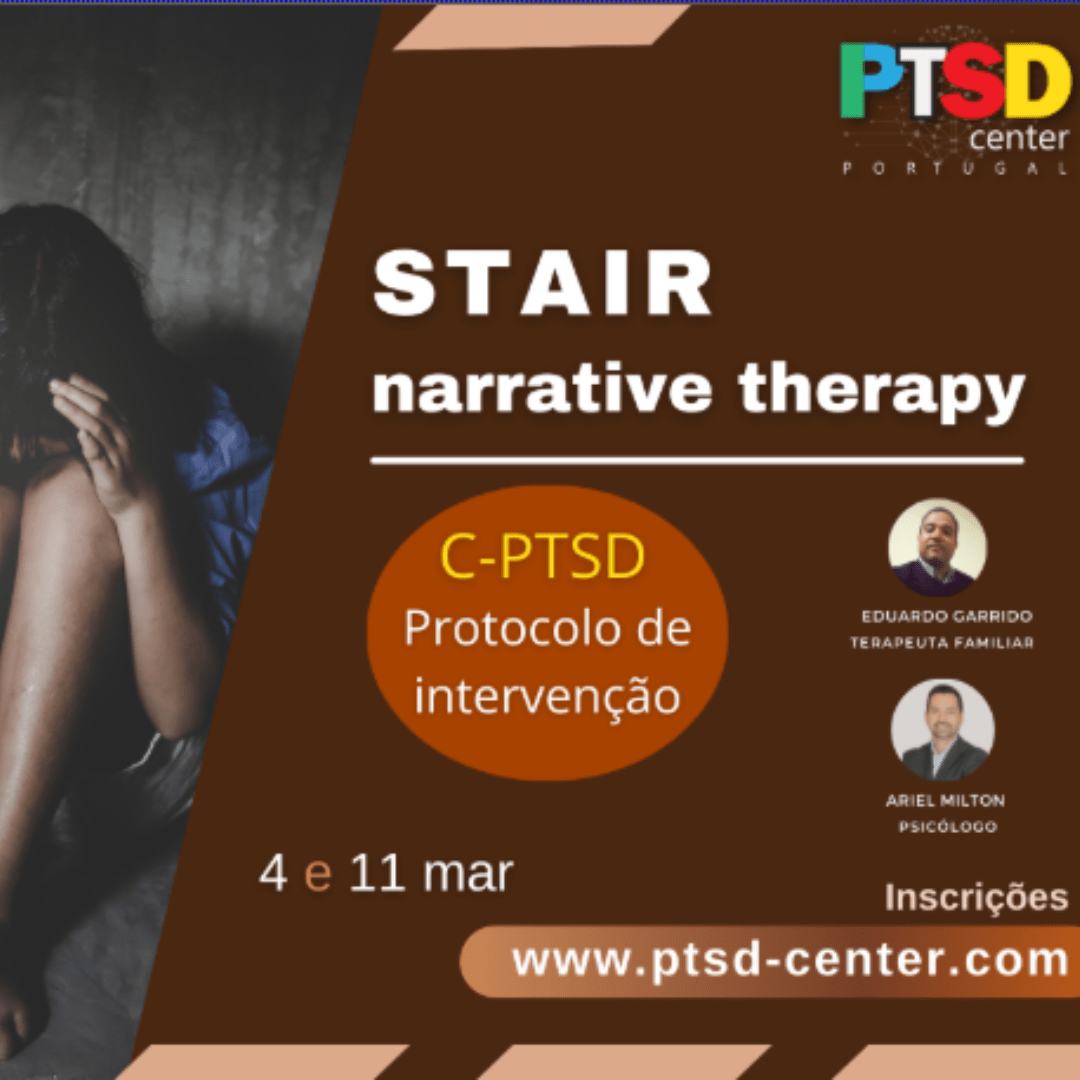
STAIR Narrative Therapy – Skills in Affective and Interpersonal Regulation
14 and 21 November 2026

Skills Training in Affective and Interpersonal Regulation (STAIR) is an evidence-based psychosocial treatment combining traditional PTSD trauma-focused work (Narrative Therapy) with skills training addressing a broad range of difficulties in everyday functioning arising from problems managing emotions and relationships.

Many therapies are effective at reducing PTSD symptoms, and the most effective involve revisiting and re-evaluating traumatic memories. However, difficulties in everyday functioning often persist even after PTSD symptoms have resolved.

The main aim of STAIR Narrative Therapy is to improve functioning by reducing PTSD symptoms and improving or restoring emotional regulation and interpersonal skills.
REGISTRATION 
More Training Courses Coming Soon!
Follow Us on Social Media
and Keep Up with Our Latest Training Opportunities.

Events Past Events

PTSD Center Training 2
Online Training – 2nd Edition – Advanced Course in Post-Traumatic Stress Disorder
Facilitator: Ariel Milton ▪ Sérgio Fonseca ▪ Gabriela Salazar (Psychologists) - Eduardo Garrido (Family Therapist) - Inês Barroca (Child and Adolescent Psychiatrist) - Ana Escobar (Psychologist)
Duration: 40 hours (online)
Dates: 26 September to 24 October 2026
Schedule: Saturdays (9:00 am–1:00 pm) ▪ Tuesdays (8:00 pm–10:00 pm) ▪ Thursdays (8:00 pm–10:00 pm) ▪ Final assessment on 22 October (online test)
Online course fee: ● €250 – Psychologists ● €140 – Junior Psychologists ● €120 – Students

PTSD is a common psychiatric condition that can arise in response to an extreme traumatic event (for example, a serious road accident, rape, assault or kidnapping), leading to symptom clusters involving re-experiencing, avoidance, negative changes in thoughts and mood, and heightened arousal. The latest guidelines recommend cognitive behavioural therapies as first-line treatment for PTSD.
REGISTRATION

Accreditation OPP 25 credits

Training area: Clinical and Health Psychology and Forensic Psychology 

Live-Stream Training – PTSD Assessment in Crisis Situations
Trainer: Ariel Milton (Psychologist)
Duration: 7 hours + 1 hour (summative assessment)
Dates: Live session – 19 and 26 April ● Summative assessment – 29 April 2025
Schedule: Saturdays 19 and 29, 9:30 am–1:00 pm ● Tuesday 29, 8:00 pm–9:00 pm
Fee: ● €80 – Professionals ● €70 – AIBAPT members ● €55 – Higher education students ● €45 – Students from partner institutions

This practical training course aims to address different aspects of the trauma spectrum in primary healthcare, psychiatry and psychology services, victim-support centres and war-veteran support services, among others. It introduces the psychometric instruments most commonly used for PTSD screening, monitoring and assessment: PC-PTSD-5 / LEC-5 / PCL-5 / CAPS-5. The course begins with a brief overview of PTSD for participants who are less familiar with the field, the characteristics of the disorder and its impact on health. More specialised training, such as the “Advanced PTSD Course”, is recommended for those seeking a deeper understanding.
REGISTRATION

The psychometric instrument will be provided Psychometric instrument and the necessary supporting materials.

7th Edition – Personality Assessment Workshop – “Mini-Mult”
Facilitator: Ariel Milton ▪ Sérgio Fonseca (Psychologists)
Duration: 4 hours (online)
Dates: 5 April 2025
Schedule: 9:00 - 13:00
Online course fee: €80 – Professionals €70 – AIBAPT members €50 – Higher education students €45 – Students from partner institutions
A paper version of the instrument will be provided free of charge
Digital instrument: additional €15 per person.


The Mini-Mult is an abbreviated version of the MMPI. Although it retains most of the characteristics of the MMPI, several improvements were introduced to make this instrument more discriminating, including new items assessing areas not covered in the previous edition, more carefully worded items, more comprehensive validity indices and highly useful new supplementary scales.
LEARN MORE

The following will be provided: Psychometric instrument and the necessary supporting materials.

Training area: Clinical and Health Psychology   

PTSD Center Training 3

Trauma-Related Guilt Course

Facilitator: Ariel Milton (Psychologist)
Duration: 3 hours
Dates: 29 March 2025
Schedule: 9:30 – 12:30
Fee:
● €80 – Professionals ● €60 – AIBAPT Members ● €40 – Higher Education Students ● €35 – Partner Students

Many of us learn about guilt as part of normal childhood development. Guilt alerts us when we step beyond the boundaries of our core values. Feeling guilty prompts us to examine how our behaviour affects other people and ourselves…

Objective:
▪ Help trainees recognise and identify guilt in trauma survivors and address post-traumatic guilt ▪ Learn to use, score and interpret psychometric instruments for assessing guilt (Trauma-Related Guilt Inventory) ▪ Learn about psychological interventions for treating trauma-related guilt.

Our Partners

PTSD Center Training 5

AEFBAUL – Students’ Association of the Faculty of Fine Arts, University of Lisbon

Visit
PTSD Center Training 6

AEFLUP – Students’ Association of the Faculty of Arts and Humanities, University of Porto

Visit
PTSD Center Training 7

AENMS – Students’ Association of NOVA Medical School | Faculty of Medical Sciences

Visit
PTSD Center Training 8

Pharmaceutical Sciences Students’ Society, University of Beira Interior

Visit
PTSD Center Training 9

AEFDUP – Students’ Association of the Faculty of Law, University of Porto

Visit Website
PTSD Center Training 10

AEFPCEUP – Students’ Association of the Faculty of Psychology and Education Sciences, University of Porto

Visit Website
PTSD Center Training 11

AAUA – Students’ Union of the University of the Azores

Visit Website
PTSD Center Training 12

SFRCI – Trade Union of Itinerant Railway Ticket Inspectors

Visit
PTSD Center Training 13

AIBAPT – Ibero-American Association of Psychotraumatology

Visit
PTSD Center Training 14

Students’ Association of the Faculty of Education and Psychology, Universidade Católica Portuguesa – Porto Regional Centre

Visit
PTSD Center Training 15

PsicUBI – Psychology Students’ Society, University of Beira Interior

Visit

Social Media

Follow PTSD Center on social media and stay up to date with our initiatives, training courses and tips for promoting mental health and wellbeing. We share informative content, news and useful resources that can make a difference in your daily life. Join our community!